

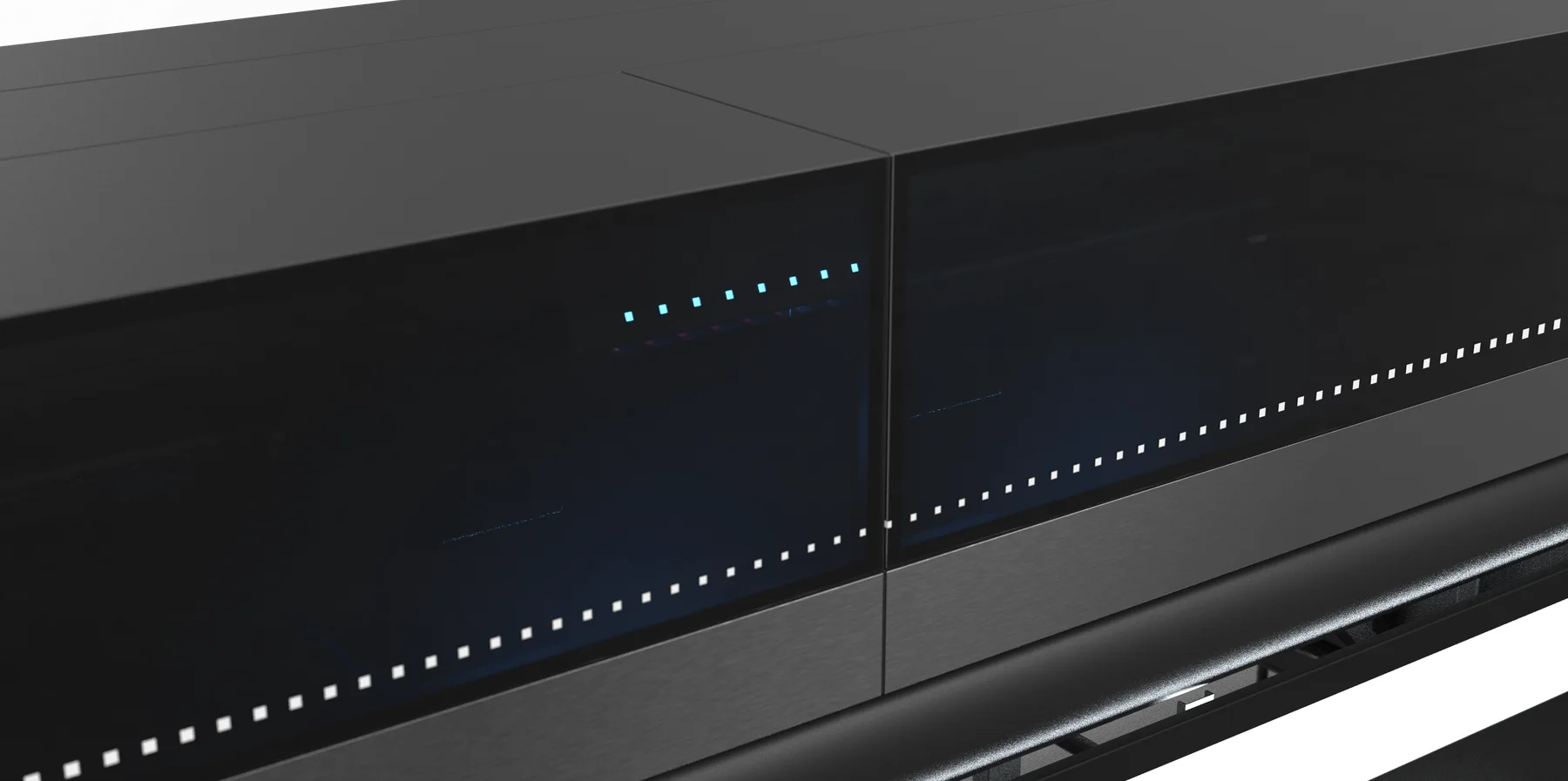
Printhead system
Industrial inkjet printheads
Equipped with the Epson T3200 inkjet printhead, each unit ejects four colours simultaneously with an effective print width of 67.2 mm. The high-frequency drive of the piezo actuator ensures stable discharge of larger droplet sizes, and a built-in heater improves compatibility with UV inks.
Automatic media thickness measurement
The system measures media thickness and adjusts printhead height accordingly, preventing printhead scratching and reducing downtime.
Anti-static system
Eliminates static electricity generated on the media surface during printing, suppressing ink mist dispersion for consistent image quality.
Printhead anti-collision device
Collision sensors on both sides of the carriage instantly detect media warping, tilting or unexpected impacts, preventing contact between printhead and media.
Advanced LED-UV curing
Dual-section LED-UV lamps suppress uneven curing and UV banding during high-speed printing while preventing substrate deformation from localised overheating. In gloss printing they produce a clear, haze-free texture.
Printhead choice
One head, four colours
The printhead is the one component a printer manufacturer cannot compensate for elsewhere. Everything downstream is built around it — how many cable looms, how many driver boards, how many ink lines and vacuum circuits, how many colour-alignment steps at install, and how many spare parts a customer has to stock for the next ten years. The T3200 fits a complete CMYK set into one head. What that changes is not a line on a spec sheet; it is the structure of the whole machine.
How many nozzles fit in one inch?
The comparison that matters is per colour, in a four-colour machine.
Density decides how many passes a given image quality needs. In a four-colour setup the T3200 puts twice as many nozzles on every colour as a Ricoh Gen6 does. You spend that either way you like — fewer passes for the same result, or a finer dot at the same speed.
It also decides how many heads a machine needs. Matching the T3200’s 300 npi per colour on a head that only manages 150 means doubling the head count and stacking them precisely — and every head added brings its loom, its driver, its ink line and its alignment step with it.
How many heads does one CMYK set need?
Each head carries as many colours as its per-colour density allows. That single number decides the whole layout — and everything the layout drags along with it.
The T3200 does CMYK in one body at 300 npi per colour. A Ricoh Gen6 manages two colours per head at that density, so CMYK takes two. A Konica KM1024a is a single-colour head — CMYK takes four.
Head count is not a number on its own. Four heads means four looms, four driver channels, four ink lines, four vacuum circuits, four things to align, four things to clean, and four part numbers in the customer’s spares cupboard.
Counts derived from each manufacturer’s own published per-colour density, the same figures listed in the table below.
Where the quality actually comes from
Two heads printing two colours each have to be aligned to one another — mechanically, at install, and again whenever a head is replaced. Four colours leaving the same silicon do not.
At install
Multi-head machines need a spacing mechanism designed for them, then each head trimmed into position by hand. The T3200 locates on precision reference holes: drop it in, and the four colours are where they are supposed to be.
Over the years
Thermal cycling, vibration and wear move separately-mounted heads relative to one another. The drift shows up as colour fringing on edges, and the operator corrects it by recalibrating. Colours on one die move together, so there is nothing to drift.
When a head is replaced
On a four-head machine, replacing one means realigning it against the other three. On a T3200 machine there is one head to change and no alignment step — which matters most for the customers we cannot reach the same afternoon.
Where the density comes from
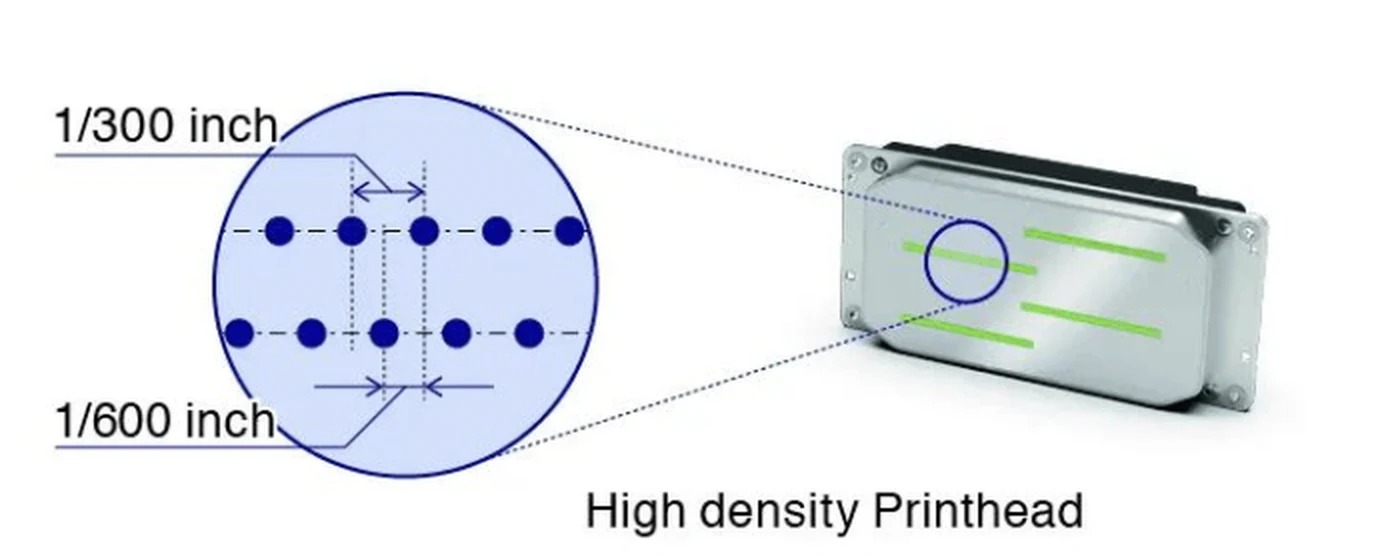
All of it starts with the PrecisionCore MEMS thin-film piezo process. MEMS manufacturing puts far more nozzles inside the same head body than comparable heads manage, and Epson’s precision nozzle and ink-flow geometry means every droplet leaves perfectly round and lands where it was aimed — consistently, across all 3,176 working nozzles.
The head carries four nozzle rows at a 1/300 inch pitch. Stagger two of them and the effective pitch halves to 1/600 inch. That is where 600 npi comes from, and why four colours can still each have 300.
Diagram: Epson PrecisionCore official technical material.
Two jetting modes, not one
The same head runs a fast binary mode and a four-level greyscale mode. Which one the job needs is a setting, not a different machine.
Binary — 7.5 pl at 48 kHz
One droplet size, fired twice as often. This is the mode behind Level 7 output: banner, tarpaulin and anything viewed from a distance, where throughput matters more than the last increment of tonal smoothness.
Greyscale — 6.2 / 9.5 / 15.6 pl at 24 kHz
Epson’s Variable Sized Droplet Technology gives three droplet volumes from the same nozzle. Small droplets keep highlight dots fine, large ones lay down enough ink in solids, and the middle size carries the transition. Gradients stay smooth — which is exactly what backlit film and soft packaging are judged on.
Six reasons it is in our machines
One head, four colours
A conventional four-colour setup combines two dual-colour heads. The T3200 fires CMYK from one. It locates on precision-machined reference holes, so there is no head-to-head spacing mechanism to design and no per-head calibration at install. Looms, driver boards, ink lines and vacuum circuits all simplify with it — a difference you can read directly off the BOM and the assembly hours.
Four-colour density does not drop
600 npi across two staggered rows, 3,200 nozzles. Split four ways that is still 300 npi per colour; a Ricoh Gen6 running four colours is down to 150 dpi each. Same single head, twice the density — which converts directly into fewer passes and faster output.
Heater built in, no external loop
The T3200 is the first PrecisionCore head with an integrated heater, which is what lets high-viscosity UV ink fire stably — and it does so without an external recirculation system, so that is one more subsystem the machine does not need. The heater holds temperature whatever the room is doing. The T3200-U3-2, April 2026, raises the ceiling to 50 °C and widens the usable ink range again.
Colour registration error goes to zero
Build four colours from several heads and thermal distortion, vibration and long-term wear accumulate into a colour shift the operator keeps correcting on the floor. Four colours from one head does not have that failure mode at all — better long-term colour stability, fewer maintenance hours, and one less thing to talk a customer through over a video call from another country.
Built like industrial equipment
A metal casing protects the electronics from the ink mist that industrial printing generates, and the reference holes let a head be replaced without re-alignment. PrecisionCore durability is not a claim on a data sheet either — Epson proves it in their own industrial printers before it reaches ours.
A mature installed base
The T3200-U3 has been on the market since July 2021 and is widely used in signage production. In practice that means spares are easy to source in Asia, technicians already know the head, ink formulations support it and RIP profiles exist. Commissioning a new machine takes noticeably less debugging than on a rarer platform — and that shows up on the customer’s first invoice, not just ours.
Head to head
| Specification | Epson T3200-U3(-2) | Ricoh Gen6 MH5320 / 5340 | Konica KM1024a |
|---|---|---|---|
| Nozzles and density | |||
| Nozzles | 3,200 (net 3,176) | 1,280 (4 × 320) | 1,024 (256 × 4) |
| Nozzle rows | 4 rows | 4 rows | 4 rows |
| Nozzle pitch | 1/300 inch | — | — |
| Nozzle density | 600 npi (2 rows) | 600 dpi (single colour) | 360 dpi |
| Colours per head | 4 colours | 2 or 4 colours | 1 colour |
| Density per colour, 4-colour setup | 300 npi | 150 dpi | 360 dpi (needs 4 heads) |
| Heads needed for CMYK | 1 | 1–2 | 4 |
| Effective print width | 67.2 mm | 54.1 mm | 72.08 mm |
| Jetting | |||
| Greyscale mode | 6.2 / 9.5 / 15.6 pl @ 24 kHz | 5–15 pl @ 26.5 kHz | 6 / 12 / 20 pl @ 22 kHz |
| Binary mode | 7.5 pl @ 48 kHz | 5 pl | 13 pl (1024i) |
| Ink viscosity | 7–8 mPa·s | Wider | Wider |
| Built-in heater | Yes (U3-2 to 50 °C) | Yes | Yes |
| Ink recirculation | Not required | Yes | Yes |
| Build | |||
| Locating method | Precision reference holes | — | — |
| Casing | Metal | — | — |
| Size / weight | 113.4 × 52.0 × 30.4 mm / 328 g | 89 × 25 × 69 mm / ~228 g | 131 × 18 × 97 mm / 150 g |
Epson figures from the published data sheet “Inkjet Head T Series” (17 June 2022) and Epson’s February 2026 update; Ricoh and Konica Minolta figures from their own product pages. A dash means the manufacturer does not publish that figure. Price and supply terms vary too much by channel, volume and region to compare here.
2026 update. Existing machines take the T3200-U3-2 directly: identical dimensions, electrical interface and jetting performance to the U3, so it drops in without a mechanical change. The heating ceiling rises to 50 °C for higher-viscosity UV inks — the cost of one spare head buys a wider ink compatibility range.
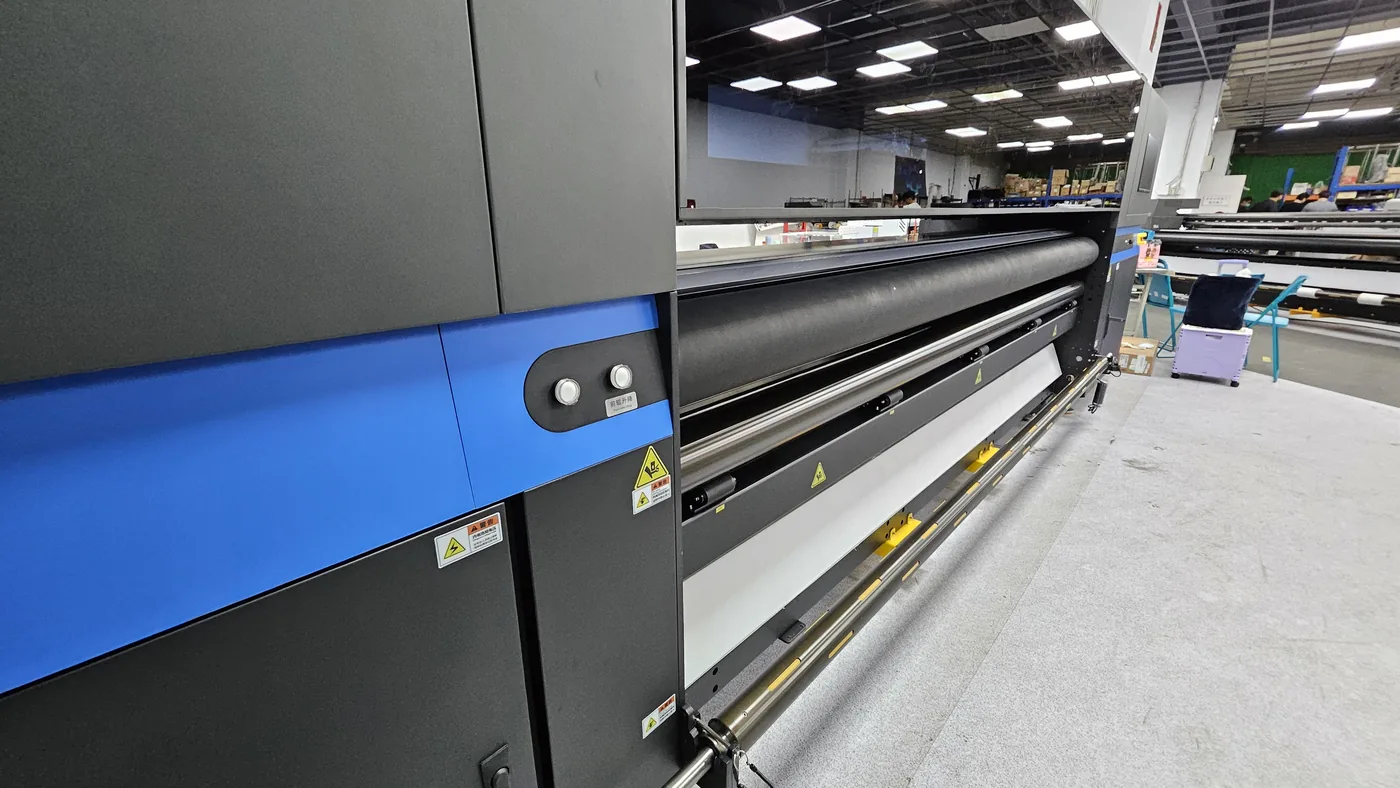
Carriage and control system
Multi-zone vacuum suction
A multi-zone vacuum platform with switchable suction areas lets operators select zones based on print size and media width — up to five independent zones. The platform includes a precision scale for easy positioning, and even thin or flexible substrates are stabilised against warping and wrinkling.
THK dual linear guide system
THK-manufactured dual linear guides, EGUS drag chains and a high-rigidity carriage beam hold travel accuracy within 0.02–0.05 mm, ensuring stable performance under demanding production conditions.
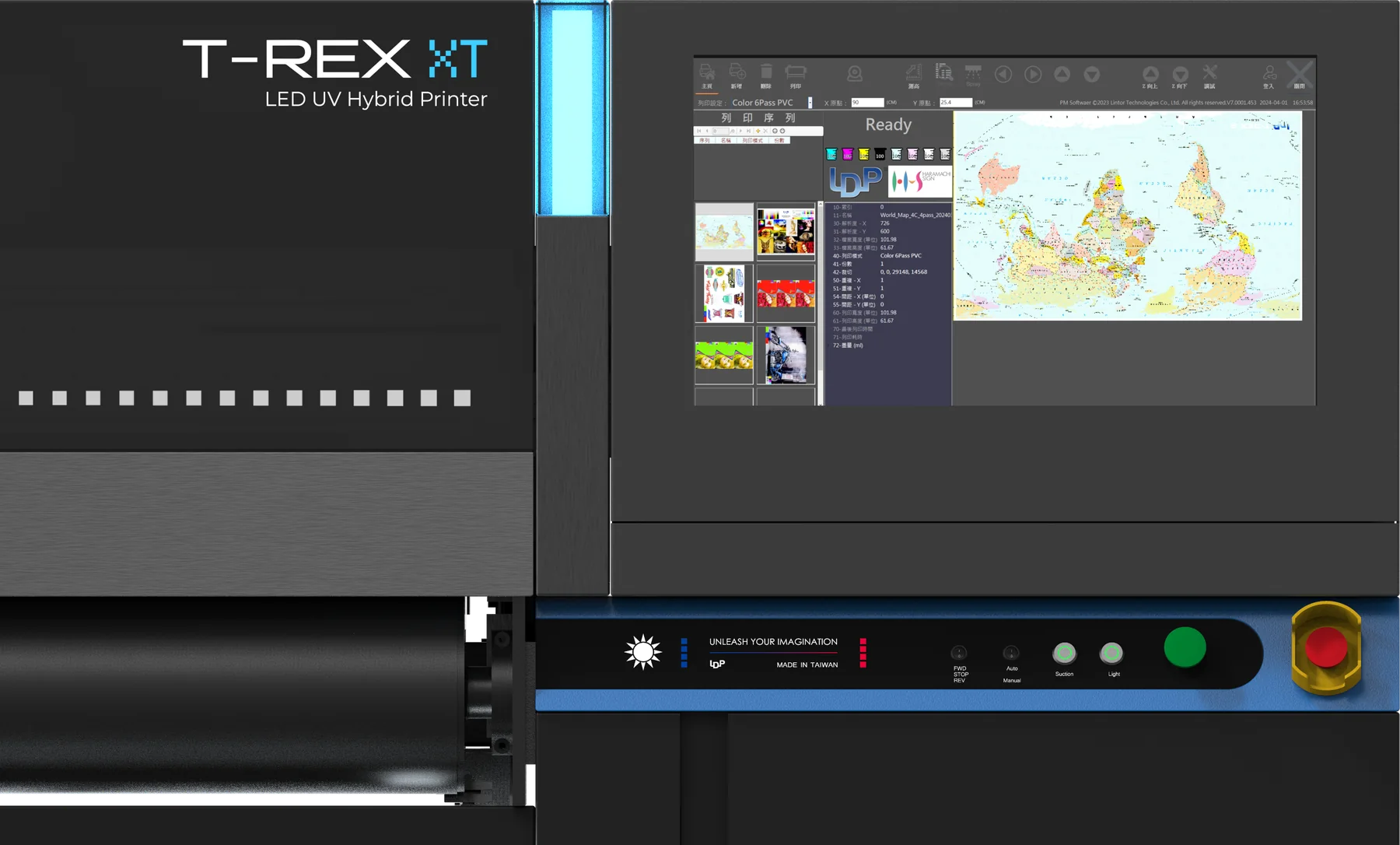
Operation and safety system
Status indicator lights
Clearly visible from a distance, the indicator lights let operators instantly recognise machine status — printing, standby, ink refilling or error.
PM7 and RIP software
With an intuitive interface, operators configure print modes, adjust colour settings and perform nozzle cleaning easily. The system supports mainstream RIP solutions — ONYX or CALDERA.
Integrated lightbox
Positioned at the front of the printing area, the lightbox enables immediate inspection of output quality, minimising media waste and time loss.
Ink and ink supply system
Light inks and white ink support
Light Cyan and Light Magenta effectively reduce graininess, ideal for close-viewing applications and high-resolution imaging. High-opacity white ink can be applied as a base layer on transparent or coloured substrates.
White ink circulation system
A specialised circulation mechanism prevents sedimentation and clogging, ensuring stable printhead performance and reducing maintenance workload.
FAQ
Questions about the technology
What printhead do LDP printers use?
Every LDP machine uses the Epson PrecisionCore T3200. One head body carries 3,200 nozzles and lays all four process colours at 300 npi per colour.
Why does nozzle density matter more than the number of heads?
Density decides how many passes an image needs. In a four-colour setup the T3200 puts twice the nozzles per colour of a Ricoh Gen6, so the same quality arrives in fewer passes — and with fewer heads to align and maintain.
Can one machine do both fast production and fine work?
Yes. The same head runs a binary mode at 7.5 pl and 48 kHz for speed, and a four-level greyscale mode for gradation. Switching between them is a setting, not a different machine.
Why LED-UV instead of mercury lamps?
LED-UV cures on contact at low temperature, so heat-sensitive film and thin plastic stay flat. Dual-section lamps also suppress uneven curing and UV banding at high speed.
Tell us what you need to print.
Whether it is a standard machine, a customised configuration or a full OEM/ODM project, our engineers will size the right solution with you.